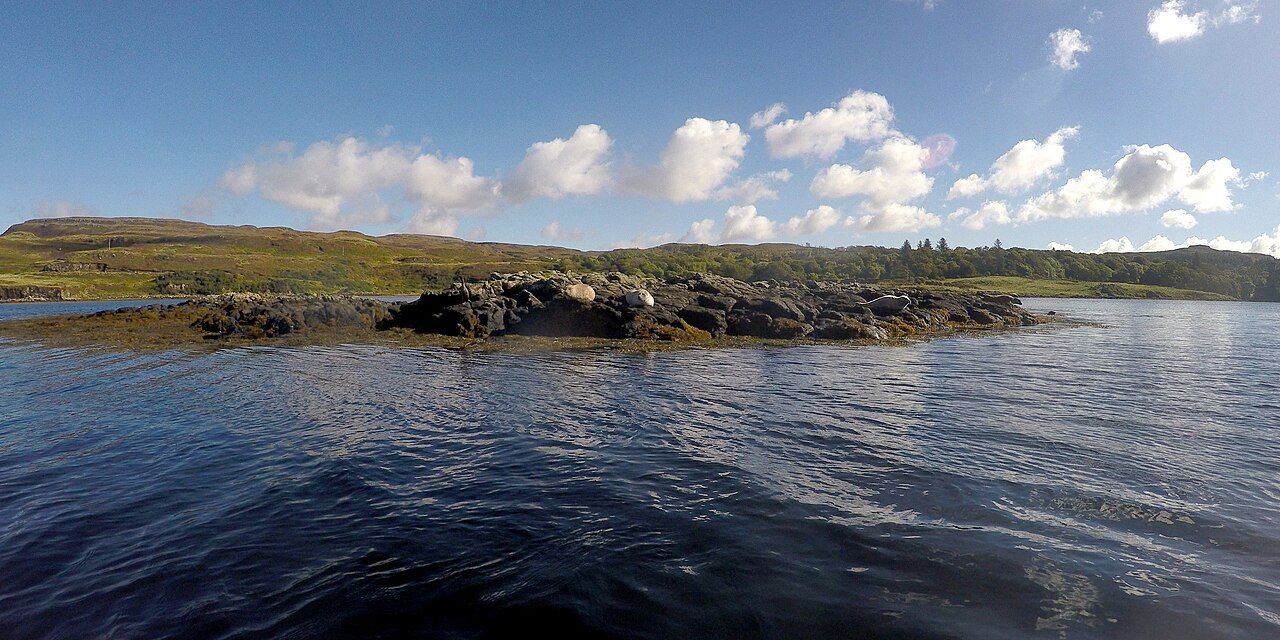
Seals on a skerry in Loch Dunvegan — photo: Andy Waddington
Loch Dunvegan is the name to keep here, and the seals make it more than a mark on paper: common seals live in the loch, hauling out on its small islands and rocks.
| Place | Loch Dunvegan |
|---|---|
| Seals | Common seals, also called harbour seals |
| Where they haul out | Small islands and rocks in the loch |
| Boat visits | Visitors can go close to the seals in summer |
| Pups | Born in June and July; able to swim within hours |
That is the simple shape of the place for anyone arriving with seals in mind: the animals are here, the rocks and small islands are where they haul out, and boats take visitors close in summer.
The name can cause a small pause. Common seals are also called harbour seals, and both names refer to the seals living in Loch Dunvegan. I have always liked how one animal can arrive under two familiar names; the dog-eared map, naturally, offers no opinion.
It is worth holding on to the word common without reading it as a promise of a lesser sight. It is simply the name used for these seals, and they are the ones visitors may see hauled out on the islands and rocks. The place is specific; the name is not a measure of worth.
Those haul-out places give the loch's seals a clear home in the account, without needing to dress the scene up. Small islands and rocks: solid words, and enough to picture the essential arrangement. I find that a map is most useful when it stops just short of pretending it can tell the whole story.
Waternish: Ruins and Empty Townships is worth a look as well.
Summer brings the boat visits close to the seals. That is a useful fact to carry alongside the names, rather than an invitation to turn the loch into a timetable: the boats take visitors close in summer, and the seals remain the reason to look.
Close is the word that matters, though it does not give a distance, and none is needed here. The encounter is described plainly: boats bring visitors near the seals. I prefer that to invented precision, which can make a place seem more easily measured than it is.
The season has another meaning for the seals themselves. Common seal pups are born in June and July, and can swim within hours. It is a remarkably brief interval between being born and entering the water, and that fact stays with me more readily than any neat little summary of wildlife.
There is no need to claim that every visit falls at the same point in that cycle. June and July are the months when pups are born; the boats take visitors close in summer. Those facts sit beside one another, without making a guarantee about what any particular visitor will see.
A name and a location are useful beginnings; the seals are living there, not arranged to make a story tidy.
Grey seals are also found around Skye. I would keep that fact separate from the account of Loch Dunvegan's common seals: it broadens the picture of seals around the island, but does not change which seals this story is about.
The law protects the seals. That belongs in any short account of them, not as a flourish but as a direct fact about their place here. For me, the sentence gives the story its firmest boundary: these are animals living in the loch, not scenery put there for visitors.
On the loose names of a map, the Point of Sleat is another name that can lead thought away from this loch; here, I keep turning back to Loch Dunvegan. The map is still dog-eared, and the distinction still matters: a place has its own account, even when the same island holds more than one.
What remains is spare and particular: common, or harbour, seals living in the loch; small islands and rocks for hauling out; summer boats bringing visitors close; pups born in June and July, swimming within hours; and protection by law.