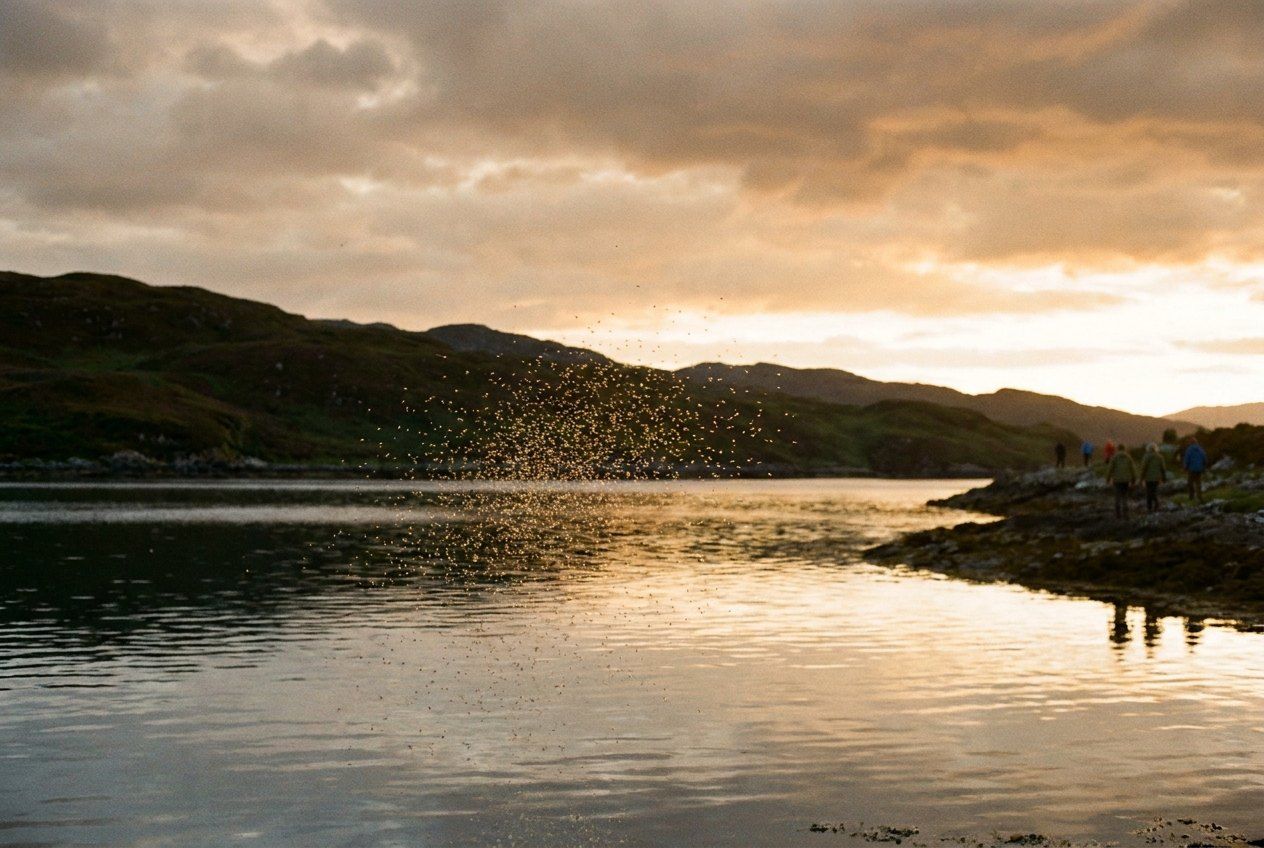
On Skye, the Highland midge is tiny, bites, and is common in the west of Scotland in summer. The details that matter are modest: stillness, damp, cloud, breeze, and the hours around dawn and dusk. Those are the parts I keep in mind.
| Conditions | Midges |
|---|---|
| Still, damp, cloudy | Worst |
| A breeze | Less of a problem |
| Exposed coasts and hilltops | Fewer |
| Late May to September | Roughly the season |
What is the Highland midge?
It is a tiny biting fly, common in the west of Scotland in summer. That is the whole useful introduction: small, biting, and familiar in the season when the island is warm enough for summer outings. Its size is not a good reason to dismiss it; the practical distinction is whether conditions suit it.
When are midges worst?
Still, damp, cloudy days are the difficult ones, with dawn and dusk the hours when midges are worst. I like a clear answer, and this is one: the combination matters, rather than a date on its own. The season runs roughly from late May to September, so the pattern belongs to a stretch of summer, not a single week.
A breeze makes them less of a problem. That is a useful shift in the calculation, not a promise that they disappear. The map in my pocket can show a route; it cannot tell me whether the air will be still, damp and cloudy when I reach it.
Do all midges bite?
Only the females bite. The Highland midge may be tiny, but that detail makes the biting part less mysterious: it is not every midge. For a visitor trying to understand what is bothering them, the distinction is simple and exact.
Where are there fewer midges?
They are fewer on exposed coasts and hilltops. The useful word is fewer, not none. Round here, the land offers different kinds of exposure, and that matters to the midge; stillness, damp and cloud remain the conditions to remember. I would rather hold on to that plain comparison than pretend there is a universal midge-free place.
A plan that includes Dinosaur footprints at Staffin still meets the same broad facts about the season and conditions. The place on a map is only part of the picture; a breeze makes midges less of a problem, while a still, damp, cloudy day is when they are worst.
Single-track roads on Skye: how driving works is worth a look as well.
What is the short version?
The Highland midge is a tiny biting fly, common in the west of Scotland in summer, and only the females bite. Expect the season roughly from late May to September; remember that midges are worst on still, damp, cloudy days and at dawn and dusk. A breeze helps, and exposed coasts and hilltops have fewer.
That is enough to make the weather worth noticing without turning every outing into a negotiation.