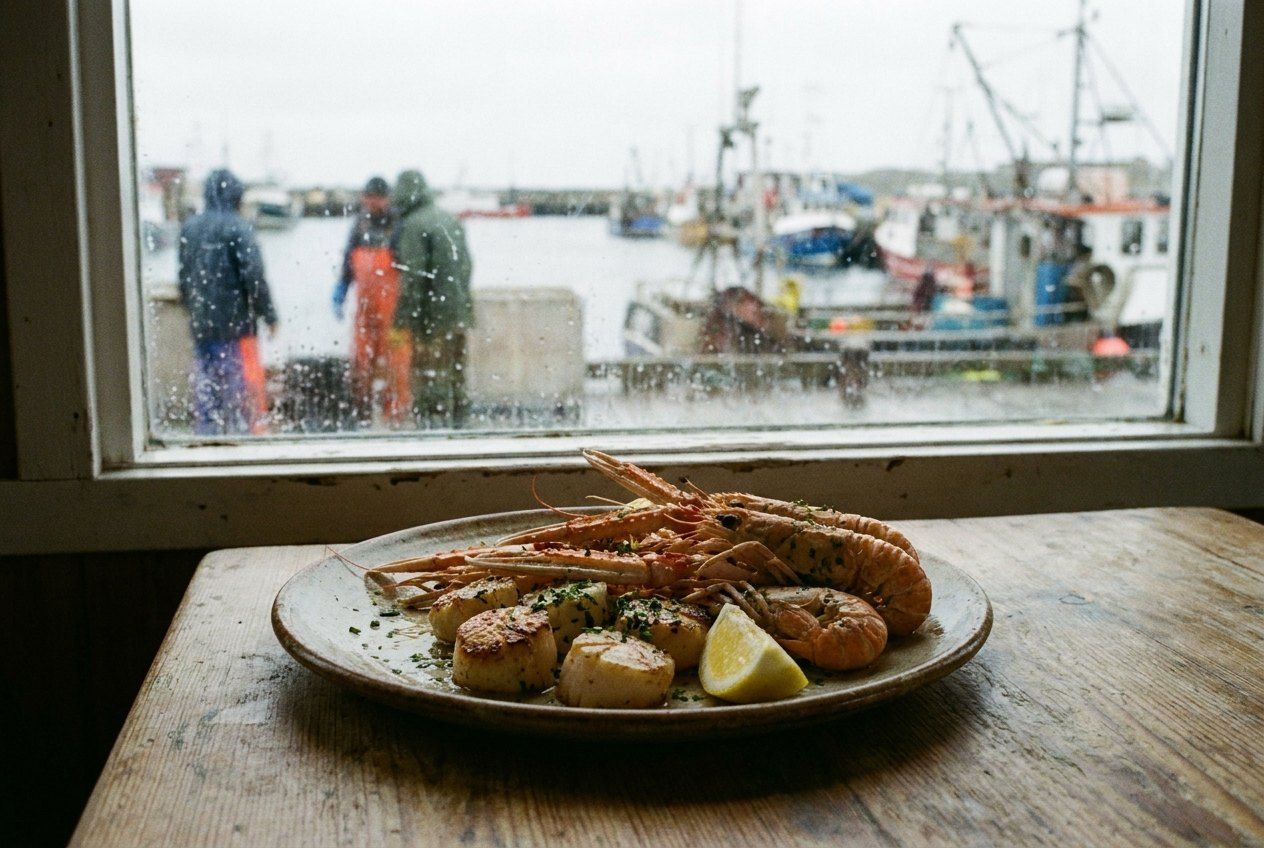
The ingredients already have their places, and those places are part of what makes eating here feel particular.
| Food | Where it comes from |
|---|---|
| Langoustines, scallops, crab and mussels | The waters around Skye |
| Oysters | Farmed on Loch Harport |
| Lamb and beef | Raised on the crofts |
| Venison | From the hills |
Langoustines, scallops, crab and mussels belong together in the mind because they come from the waters around Skye, but each name still asks for its own attention. I like that the list does not need a flourish: it is enough to know that the sea is present in the food, not merely in the view beyond it.
Langoustines carry a little complication with them. Most Scottish langoustines are exported, a plain fact that changes how I think about them on Skye; they are local to these waters, but not simply an everyday promise on every plate. That gap between where food comes from and where it goes is worth keeping in mind, without turning the ingredient into a story it cannot carry.
The map keeps the island folded to hand, while the food keeps opening it out.
The map keeps the island folded to hand, while the food keeps opening it out.
Their names are enough to make me think about the difference between a place as scenery and a place as something that feeds people. I would rather linger over that simple connection than pretend every ingredient has a tale attached, or that the same meal means the same thing to everyone who sits down to it.
Oysters give that connection a sharper point on the map: they are farmed on Loch Harport. I find the specificity pleasing. “Oysters” could remain a broad idea, detached from any one stretch of water; Loch Harport puts them somewhere definite, and gives the island’s food another address without asking for a grand account of how it got there.
Flora MacDonald at Kilmuir is worth a look as well.
Then there are lamb and beef, raised on the crofts. I like the directness of that fact, and the way it belongs beside the seafood rather than beneath it. Skye’s food is not one thing with a single emblem; its character, as I understand it, sits in these different origins held together on one island. The crofts matter to that picture, just as the waters do.
Venison comes from the hills, a short phrase that carries its own landscape without needing to dress it up. Set beside lamb and beef raised on the crofts, it makes the distinction clear: the foods have different beginnings, even when they meet in the same conversation about what Skye eats. I would not flatten those differences into a single notion of island fare. The origins are the useful part.
For visitors, the temptation is to ask for a definitive dish, as though a place must be reduced to one answer before it can be understood. I have never found that a helpful way to think about food. Here, the better starting point is a small collection of names and origins: shellfish from the waters around Skye, oysters from Loch Harport, lamb and beef raised on the crofts, venison from the hills. Those distinctions matter to me.
There is pleasure in that plainness. It leaves room for personal preference, which is where the best part of eating often begins for me: deciding which ingredient I want to think about, and not insisting that it stand for everything else. The seafood draws the eye towards the water; lamb and beef bring the crofts into view; venison keeps the hills in the picture.
I still return to the paper map, its folds and worn edges making the island a thing to hold rather than a view to collect. The food does something similar in its own way, bringing waters, crofts, Loch Harport and hills close to the table. Those are enough beginnings for me; the rest can be left to the meal.