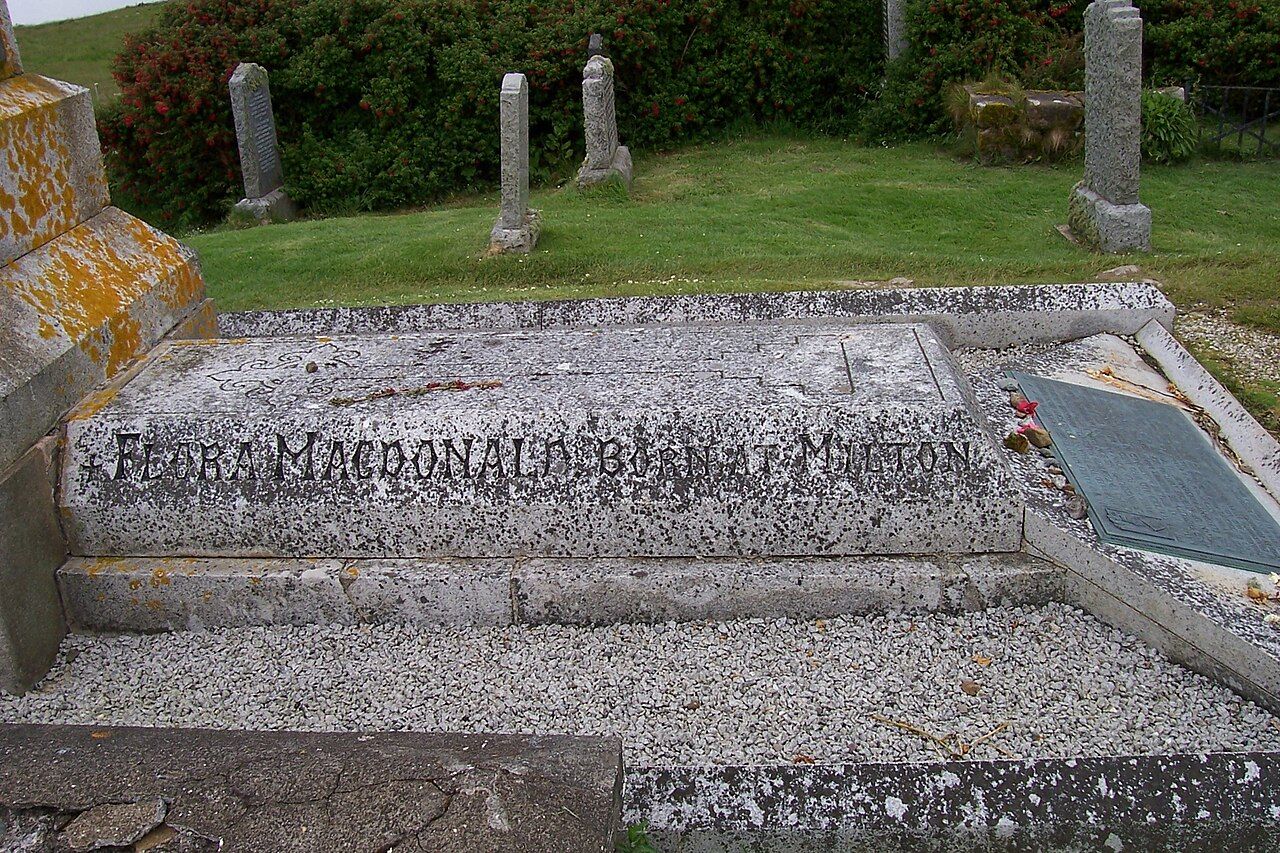
Flora MacDonald's grave — photo: Adam Cuerden
Kilmuir is where Flora MacDonald’s story rests on Skye.
| Place | Connection |
|---|---|
| Kilmuir, Trotternish | Flora MacDonald is buried here |
For visitors, that is the point of beginning: not with a grand account of the escape, but with the place where MacDonald is buried, and the long passage that brought her back to Skye.
In 1746, after the defeat at Culloden, she helped Charles Edward Stuart, Bonnie Prince Charlie, escape. She took him from Benbecula to Skye, disguised as her maid, Betty Burke.
The facts are spare, and the movement between them is striking: a defeat, a disguised journey, an arrest, a life carried away from Skye, and a return. Kilmuir gives that sequence a place to settle.
There is an odd intimacy in the disguise. Betty Burke is not a name attached to the broad sweep of a defeat or a journey between islands; she is the detail that makes the escape legible.
MacDonald took him from Benbecula to Skye as her maid. That is the whole shape of the crossing in the account we have here, and it is enough to fix the story in the mind.
Round here, the name Bonnie Prince Charlie often arrives with the Skye Boat Song close behind it. The song tells of the escape, making the journey familiar even where its details remain few.
Single-track roads on Skye: how driving works is worth a look as well.
A song can give an escape a rhythm; a place makes it harder to leave as a song alone. At Kilmuir, the story is not only about the route to Skye, but about MacDonald’s own life.
She was arrested and held in the Tower of London for a time. The phrase is brief, but it changes the balance of the story: helping him escape did not mean she simply slipped away herself.
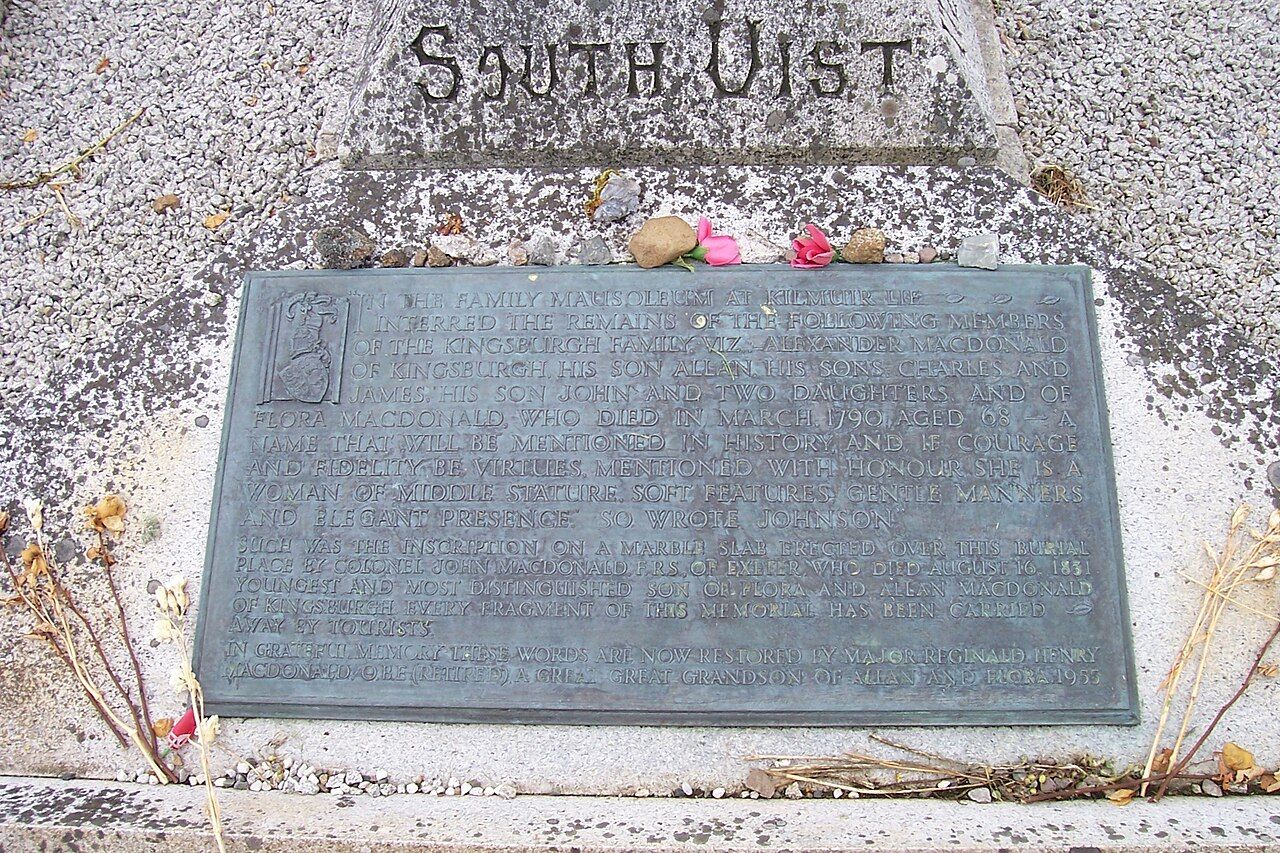
I find that turn difficult to hurry past. The journey disguised as Betty Burke and the arrest belong in the same account, even though one has become a song and the other can sit in a sentence.
Then the story moves farther away. MacDonald emigrated to North Carolina, and later returned to Skye. The words make a clean line on the page; a life is never made clean by a line.
The facts are enough: she left for North Carolina, and she came back to Skye, where Kilmuir holds her burial place.
That return matters when standing with the name Kilmuir in mind. It keeps the story from ending at the moment of escape, or at the Tower of London, or with emigration.
Instead, the place belongs to the full arc: the woman who helped Bonnie Prince Charlie, the woman arrested afterwards, the woman who emigrated, and the woman buried at Kilmuir.
A visitor can carry all of that without needing a longer list of dates. The one fixed year here is 1746, when the defeat at Culloden preceded the escape from Benbecula to Skye.
Kilmuir is not simply the end of a route; it is part of MacDonald’s return.
That is a different kind of travel story from the one the song offers. The song tells of the escape; Kilmuir asks the mind to hold what came after, and what came home.
There is no need to claim that the place explains everything. It gives the story a point of rest, which is not the same as an answer, and feels more honest to me.
MacDonald’s part in the escape is the reason her name travels so widely in the telling. Her burial at Kilmuir makes the story more than a moment of passage through Skye.
When I think of her, I think of that contrast: Betty Burke as disguise, the Tower of London as arrest, North Carolina as emigration, and Kilmuir as return and burial.
The map remains dog-eared, and the story refuses to fold into a single line. It begins with an escape after Culloden, but at Kilmuir it is allowed to continue.