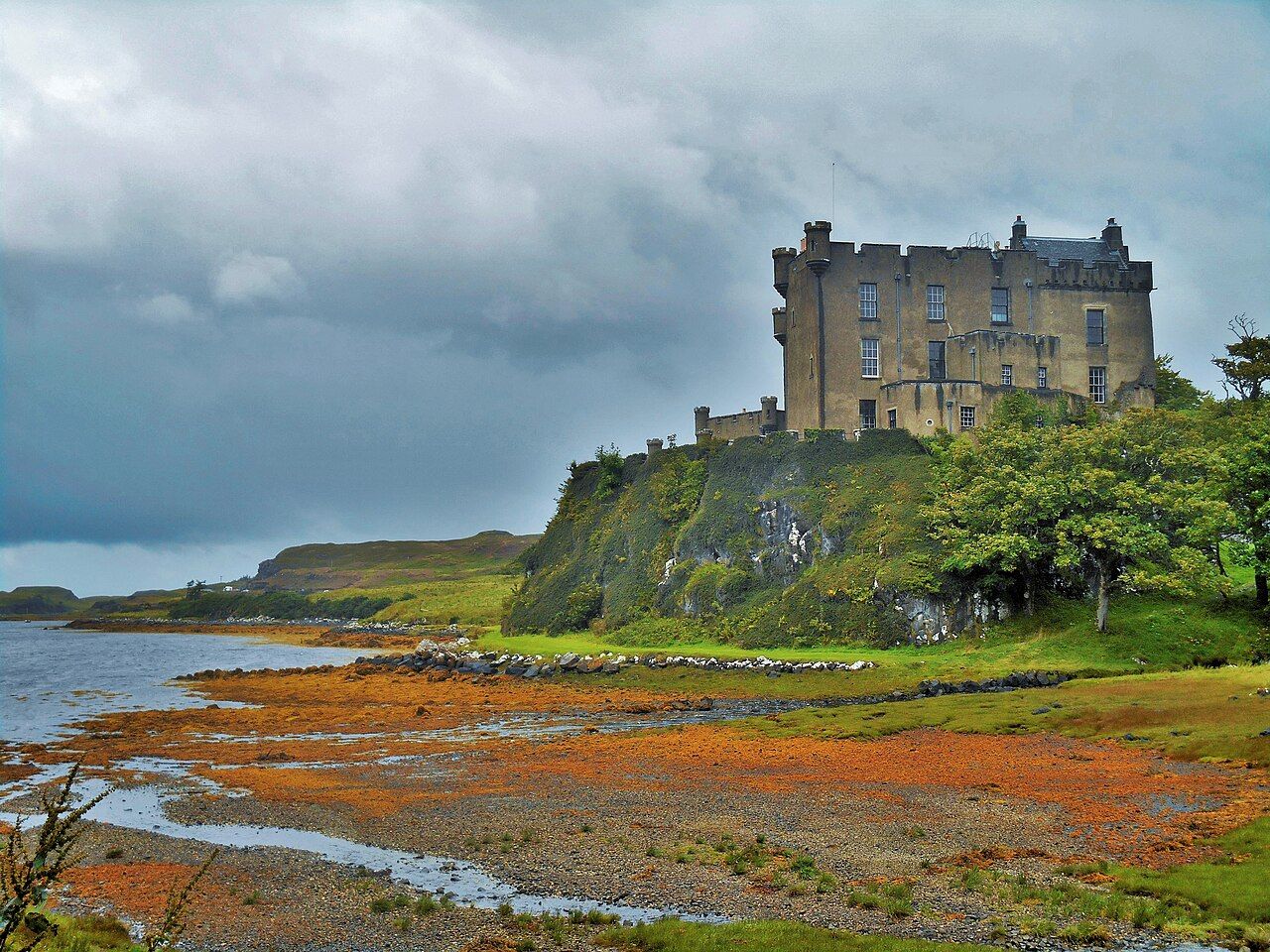
Dunvegan Castle at low tide — photo: Sarahteeco
The Fairy Flag gives it another.
| Place | Dunvegan |
|---|---|
| Castle | Seat of the chiefs of Clan MacLeod |
| Gardens | Open to visitors |
| Seal-watching boats | Run near the castle in summer |
There is a useful simplicity to the first fact: this is the seat of the chiefs of Clan MacLeod. The castle has been lived in by the MacLeods for about 800 years.
That span can be held in a sentence, though it is harder to take in as a visitor. A seat is not just a point on a map; here, the word carries the weight of a family’s long presence.
Round here, I like a place that gives you a solid thing to look at before it offers a story. The castle is there on the loch shore, and the flag is there within it.
It is a silk banner, said to have magical powers. That phrase is the beginning of the Fairy Flag’s story, not a claim I would tidy into something more certain.
Legend says that, when waved, it will save the clan in battle. The wording matters: the promise belongs to legend, and the flag’s power is not something to describe as settled fact.
Tradition says the flag has been waved twice. Twice is an exact figure, but the careful part of the sentence is just as important as the number.
A silk banner, a clan, a promise of rescue in battle: those pieces already leave plenty of room for wonder.
I rather like that limit.
The castle’s place as the MacLeod seat gives the banner a setting that is more than a room or an exhibit. It belongs to a house lived in by the same clan for about 800 years.
That does not make the legend less mysterious. It makes the relation between the object and the people around it easier to understand, without pretending that understanding accounts for everything.
For visitors, the gardens around the castle are open. They offer another way to spend time at Dunvegan, apart from looking towards the flag and taking in its story.
I would not hurry past the distinction between those parts of a visit. The gardens are a place to be among; the flag asks for a pause over what is said about it.
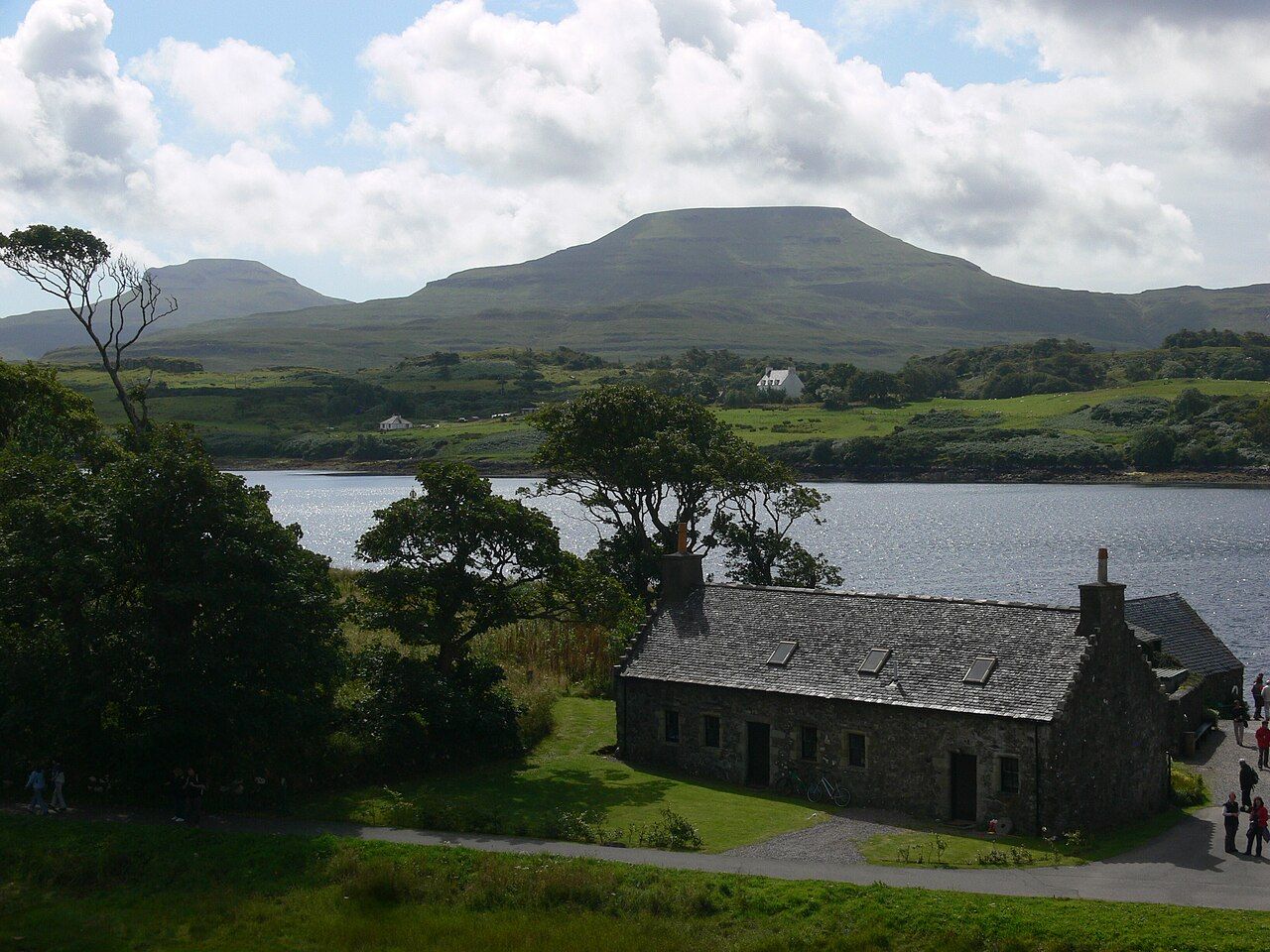
Neither needs dressing up. The gardens are open to visitors, and the castle holds the Fairy Flag. Those plain facts are enough to give the visit more than one centre.
The loch shore keeps the castle’s setting in view. The seat, the banner and the gardens all belong to Dunvegan, but they ask for different kinds of attention.
There is also the water beyond the castle. Seal-watching boats run near it in summer, making the loch part of the visit in a different way from the castle and gardens.
Seals on Loch Dunvegan is worth a look as well.
I like that the boats are described by what they do and where they run: near the castle, in summer.
The season belongs in the sentence too. The boats run in summer; that is the fact, without a prediction about what the day will bring or what else might be seen.
Some places are easiest to remember through one object, and the Fairy Flag has that pull. Still, reducing Dunvegan to the banner would leave out the seat and its long connection to Clan MacLeod.
About 800 years is not a decorative number here. It gives a measure of how long the MacLeods have lived in the castle, while leaving the visitor to imagine the generations contained within it.
The flag’s tradition has a different measure: it has been waved twice. I find the exactness of that claim striking beside the uncertainty carried by the words “said to have magical powers”.
That contrast is the heart of Dunvegan for me. A real castle on the shore, a family seat with a long history of occupation, and a silk banner whose power comes to us through legend.
At Dunvegan, the solid and the legendary stay side by side.
So the visit has its clear parts: castle, gardens open to visitors, and boats near the castle in summer. Then there is the flag, which makes a plain list feel inadequate.
I would leave it that way. The Fairy Flag is said to have magical powers; legend gives it a promise in battle; tradition says it has been waved twice.
Those are not details to improve with extra certainty. They are the story as it stands, held at the seat of the chiefs of Clan MacLeod, on the shore of Loch Dunvegan.
For all the map can tell me, Dunvegan is a point beside the loch. For all the flag can tell me, its legend stays a legend. Both are good reasons to stop there.