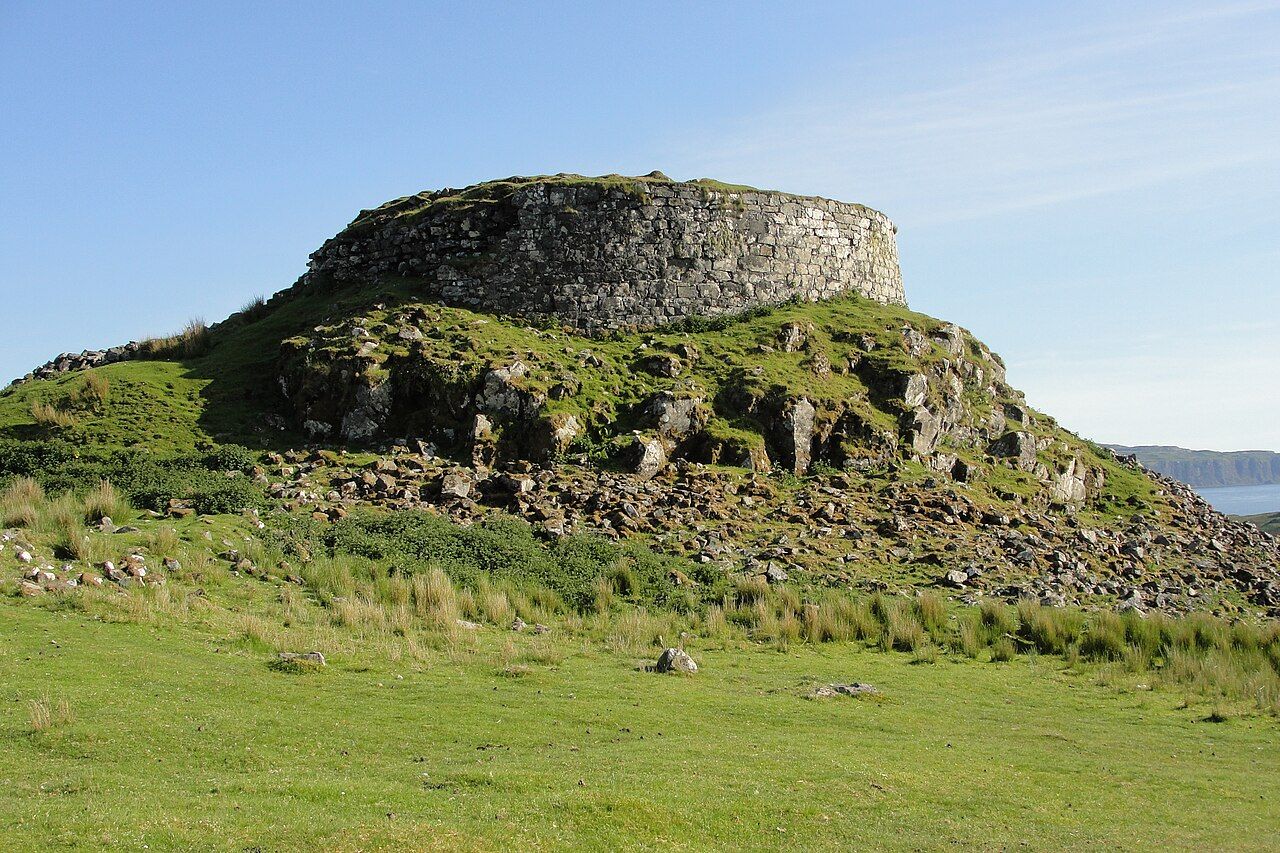
Dùn Beag broch, Struan — photo: Nessy-Pic
The knoll above Loch Bracadale gives Dùn Beag its place in the landscape before the broch itself comes into view. The short walk uphill from the road is enough to leave the road behind, and to bring the round tower into the foreground.
| Place | Bracadale |
|---|---|
| Setting | A knoll above Loch Bracadale, near Struan |
| Walk | Short and uphill from the road |
| Structure | Iron Age round, dry-stone tower with a double wall |
Dùn Beag is the best-preserved broch on Skye. That is a useful distinction, though it does not tell the whole story: the surviving walls reach about four metres in places, and the tower still asks to be understood as a building, not simply a name on a map.
A broch is a round, dry-stone tower with a double wall, built in the Iron Age, roughly 2,000 years ago. Brochs are found only in Scotland, mostly in the north and the islands. Those few facts give Dùn Beag a wider frame, without taking it away from this particular knoll above the loch.
The phrase “double wall” is easy to pass over, but it is the detail that makes the broch more than a round outline. The thickness is part of its form, and the surviving stone keeps that form readable; the building can be understood as a structure, not merely as a shape.
A map can mark the knoll and the loch; it cannot make the double wall feel like a decision made in stone, or tell the mind what to do with a tower built roughly 2,000 years ago.
The shape is simple to name, but difficult to reduce to a diagram.
The shape is simple to name, but difficult to reduce to a diagram.
Round, dry-stone, double-walled: each word is plain enough, and each carries the eye back to the structure. The walls are not a distant outline, but the part of the broch that survives most clearly. In places they still reach about four metres, which gives the building a measure that the word “ruin” can blur.
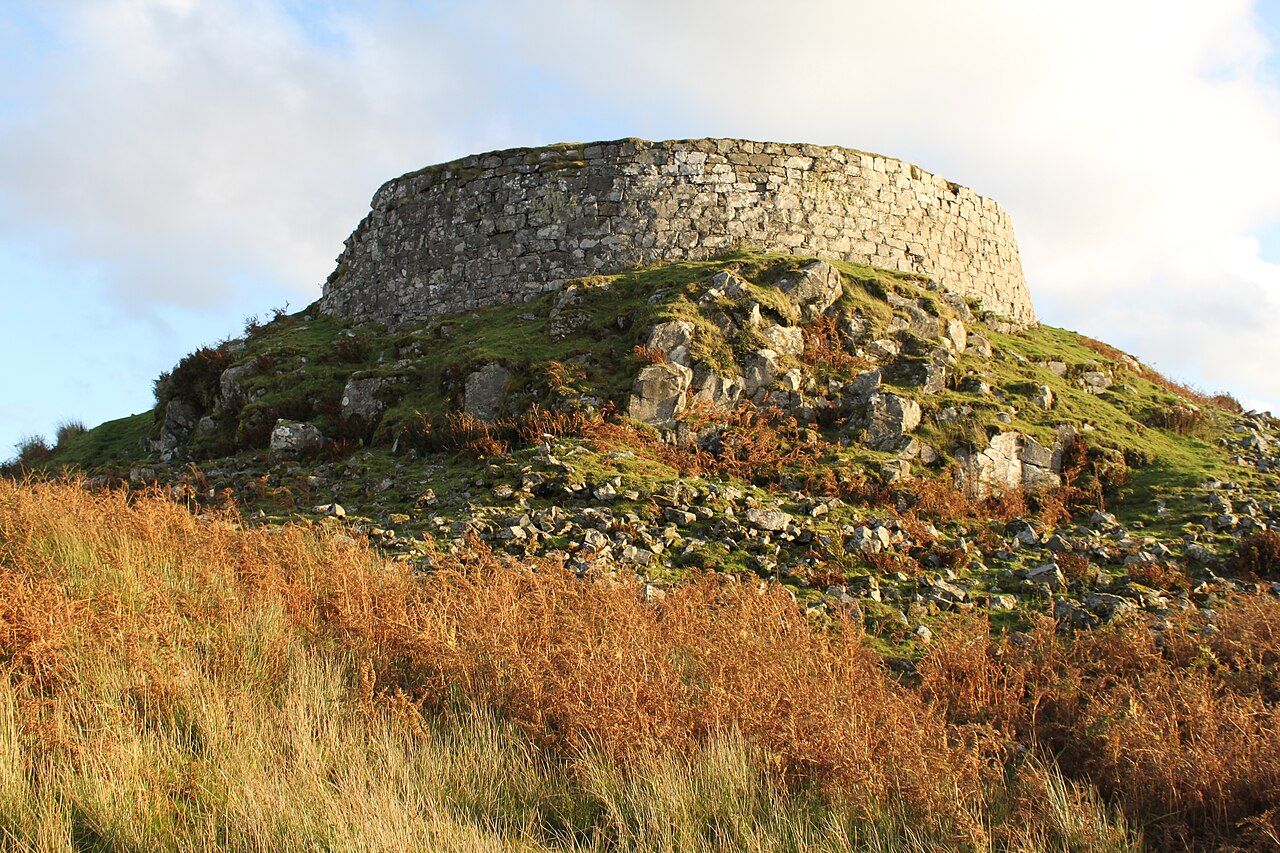
That qualification matters: the walls survive to about four metres in places, not as one even measure all round. I find the distinction useful, because it leaves the eye with the real shape of what remains rather than smoothing the broch into a tidy figure.
Inside the wall, steps once led to upper floors. That detail changes the sense of the place. The broch was not only a ring to look at from outside; its wall held a route upwards, and the building had levels beyond the ground beneath the feet.
The steps make the wall seem less like a boundary and more like part of the building’s working arrangement. There is a direction in that small fact, from the ground towards upper floors, though the steps themselves belong to what once was.
There is a temptation to fill in what the facts do not supply: who climbed those steps, what the upper floors held, or how the tower fitted into daily life. I leave those questions open. What remains is already enough to make the structure legible in part, and to show where imagination must stop.
Here, the practical approach is uncomplicated to state: Dùn Beag is a short walk uphill from the road. The knoll is above Loch Bracadale, near Struan. Beyond those points, the place needs no itinerary dressed around it; the walk and the tower are the substance of the visit.
Waternish: Ruins and Empty Townships is worth a look as well.
For me, the pleasure is in holding the broad fact and the close one together. Brochs belong to Scotland, mostly its north and islands; Dùn Beag belongs to this knoll above this loch. It is the best-preserved broch on Skye, and its surviving walls make that distinction tangible without requiring any grander claim.
There is enough in the name and the setting to keep the wider subject close at hand: an Iron Age tower, roughly 2,000 years old, above Loch Bracadale. Yet the place does not need to stand for every broch. Its own double wall, steps and rise above the water are quite enough to hold attention.
The map goes away; the round wall stays in view.