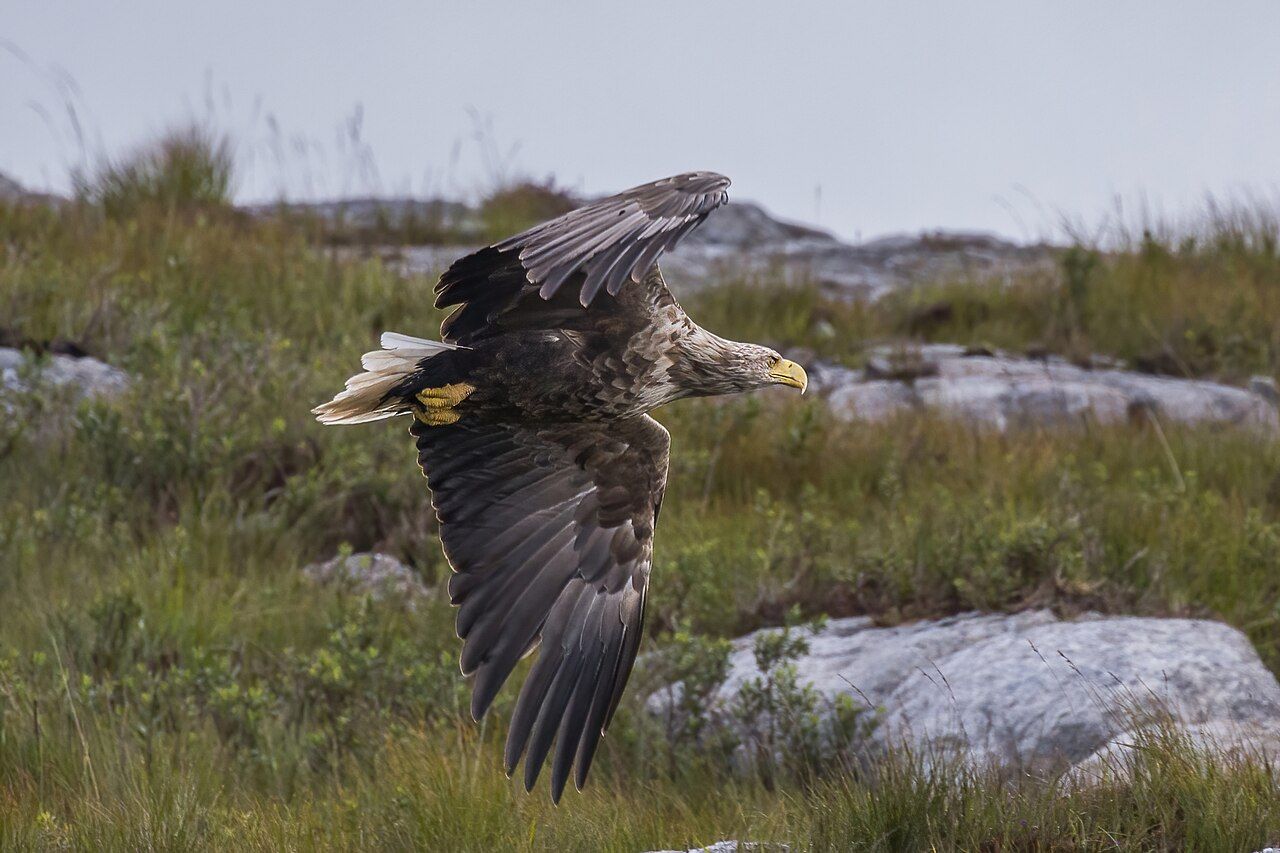
A white-tailed eagle in flight — photo: Charles J. Sharp
At Portree, the Sound gives this story its shape: the sea below, Skye around it, and the thought of a white-tailed eagle taking fish. The bird is here now, though its presence has a long history.
| Place | Portree |
|---|---|
| Bird | White-tailed eagle, also called sea eagle |
| On the water | Boat trips from Portree go out to see them catch fish |
White-tailed eagles are the largest birds of prey in Britain.
A sea eagle makes the word largest feel less like a measurement than a change in the scale of the day. It is a bird with a name that belongs to both land and water, and around here those two are never far apart.
A sea eagle makes the word largest feel less like a measurement than a change in the scale of the day.
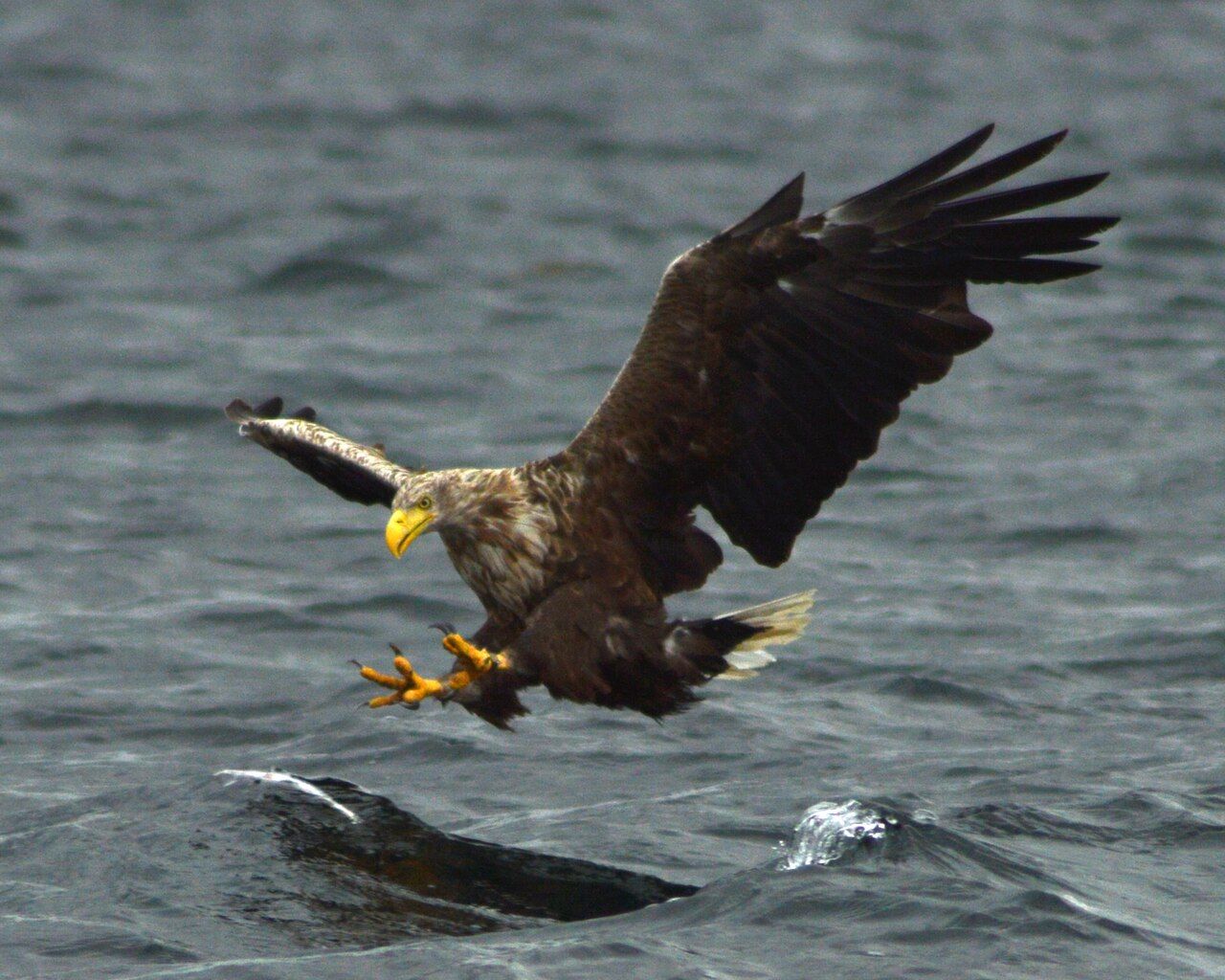
The Sound is not just a backdrop to the name. Boat trips from Portree go out to see the eagles catch fish, putting the bird’s relationship with the sea at the centre of the experience.
That wording matters. The trips go out to see them catch fish; it tells us what people hope to witness, not what happens on every outing. I prefer the plainness of that distinction to a promise dressed up as certainty.
There is something compelling about watching for a bird whose name is already so large in the imagination. The dog-eared map is no help with the actual moment, of course, but I like having it close all the same.
The birds were not always part of Britain’s living landscape. White-tailed eagles died out here in the early twentieth century, a stark sentence that changes the meaning of seeing them now.
It is easy to let a short sentence carry too little weight. Died out: not simply scarce, not merely difficult to find, but gone from Britain, before a return began through reintroduction.
That work began on the Isle of Rum, where white-tailed eagles were reintroduced from Norway starting in 1975. The history gives the bird’s present-day place around Skye a longer reach than a single view from the water.
Rum and Skye belong to the same account of return, though the facts are spare: the reintroduction began there, and the eagles now nest around Skye. I like that the story can be told without embroidery.
The Braes and the Battle of 1882 is worth a look as well.
On a dog-eared map, a name can look fixed and finished. The story here is less tidy: a bird lost from Britain, brought back through reintroduction, and now nesting around an island whose name takes up space beside the sea.
That does not make every outing a lesson in history. The immediate appeal is more direct: a boat going out from Portree, the possibility of seeing an eagle catch fish, and the knowledge that this is a bird of considerable size.
But history is present in the background whether anyone is thinking about it or not. The white-tailed eagle around Skye is not simply an emblem of wildness; its return is part of what makes its current presence meaningful.
There are golden eagles on Skye as well, mostly in the hills. I find the difference in their names a useful beginning: one points plainly to the sea, while the other is most often associated here with higher ground.
That is not a way to turn the island into two neat halves. It is a small guide to attention, and a reminder that the bird over the water is not the only eagle belonging to Skye.
Portree is the practical starting point for this particular story because boat trips go out from there to see white-tailed eagles catch fish. The place and the bird meet without much need for an extra explanation.
Raasay belongs in the frame too, as part of the Sound’s wider setting. Around Portree and Raasay, the sea-eagle story feels most itself when kept close to the water, rather than reduced to a list of sightings.
I return to the paper map when I want to hold the place still for a moment. Its dog-eared edges are a modest comfort; the Sound, and the bird’s history across it, refuse to stay still in quite the same way.
It is the largest bird of prey in Britain, it catches fish, and it now nests around Skye; those facts have enough room in them already.
So the Sound carries two kinds of looking: the outward search from Portree, and the inward one that follows the bird’s return from extinction in Britain to a place in the present landscape.
When the map is folded away, Portree remains the start of the view, and the sea its open middle. Somewhere in that account is the sea eagle, still making the word largest feel newly useful.