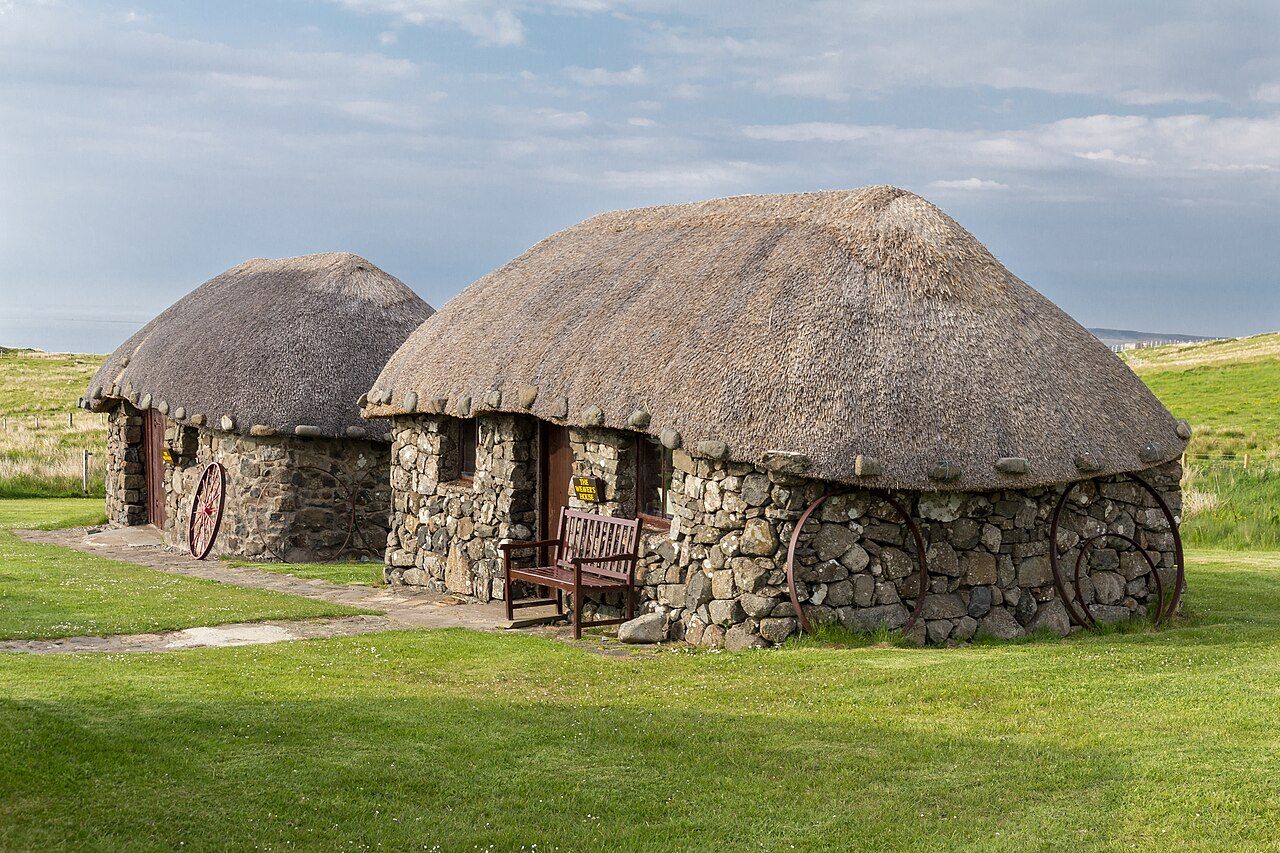
Black houses at Kilmuir — photo: JoachimKohler-HB
At Kilmuir, a group of thatched cottages gathers the eye around a kind of home built from thick stone walls and a roof of thatch. The houses are kept as a museum of island life.
| Place | Kilmuir, Trotternish |
|---|---|
| What is here | A group of thatched cottages kept as a museum of island life |
| Nearby | Flora MacDonald’s grave |
A black house is a traditional Highland house, though the name alone tells little about the life held inside it. The walls and roof are the first part of the account; the rest is in how people lived.
Families and animals often lived under the same roof. That fact changes the way I look at the cottages: not as an outline set apart from ordinary life, but as a home shared between people and animals.
It is an arrangement that asks us to imagine closeness without pretending to know every detail. The house brought different needs under one roof, and its form belongs to that practical, joined-up way of living.
A peat fire burned in the middle of the floor, with smoke escaping through the thatch. There is no chimney in that description, only a fire at the centre and a path upwards through the roof.
That is a striking arrangement to picture now. The smoke did not disappear into a separate part of the house; it moved through the same shelter that held the family and animals.
The thatch is not merely a finishing line above the stone. It is part of the account of the fire, the roof, and the way the house worked, all tied together in one structure.
At Kilmuir, the cottages do that more plainly, by making their shape the subject.
The story of the bridge belongs to another scale; here, attention rests on a home and the demands gathered within it. A black house is easier to understand when we think of it as lived space.
There is a tendency to let a thatched roof stand for an old way of life by itself. Round here, that seems too thin an account: the roof matters, but so do the thick walls, the fire and the shared interior.
Each detail changes the others. Stone holds the house’s shape; thatch covers it; the peat fire burns in the middle of the floor, and smoke escapes through the roof above.
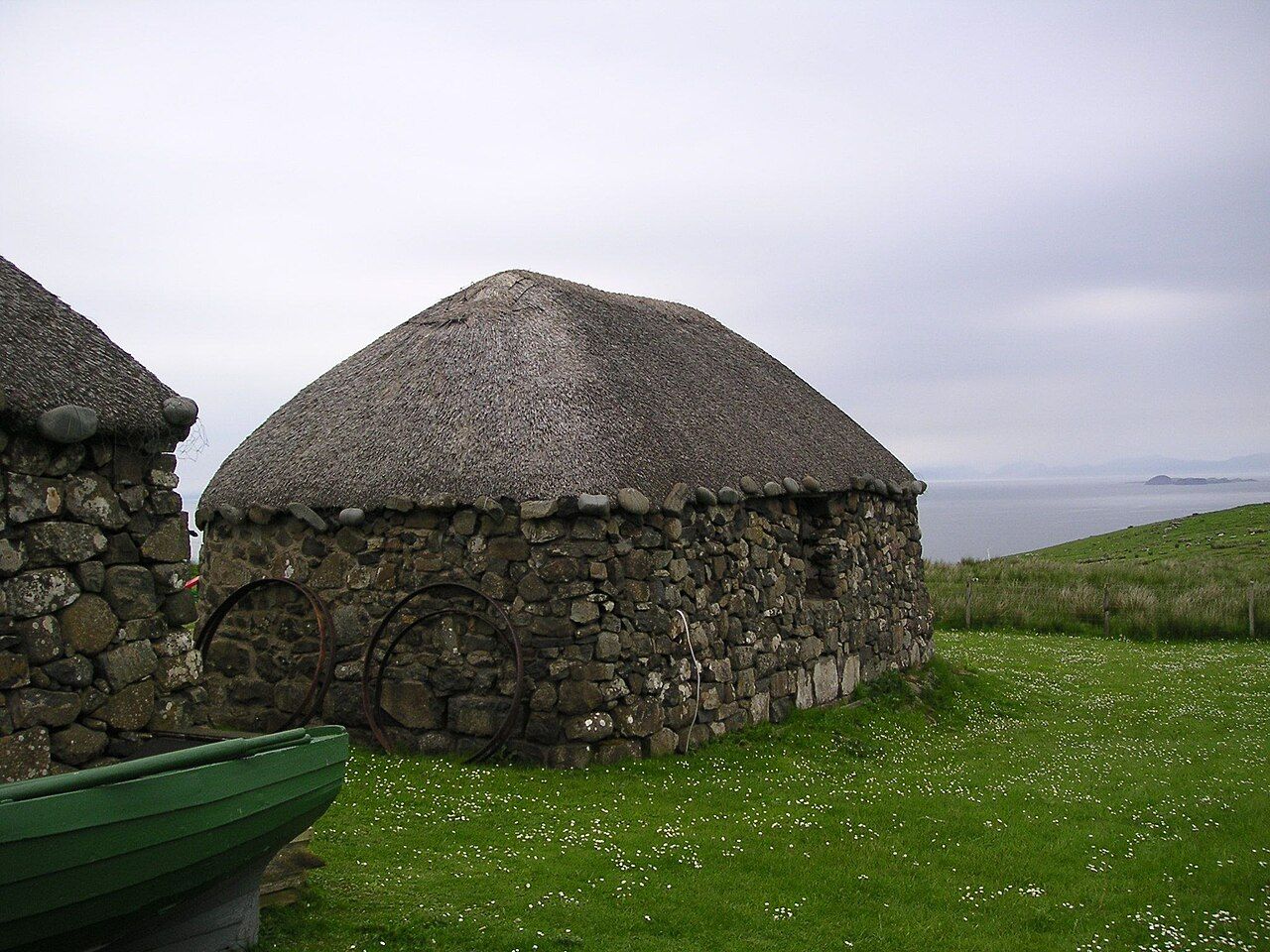
Nothing in that arrangement feels like decoration. It is a form of shelter with its parts closely bound to the life carried on inside, and that is what makes the cottages worth considering slowly.
Black houses were common until the twentieth century. The cottages at Kilmuir belong to a way of life that did not end in some distant, sealed past; the fact gives the houses a nearer history.
That measure of time is enough.
For visitors, the museum setting offers a way to meet the houses as more than a striking outline. Their details connect a building’s form to the everyday arrangement of family, animals, fire and smoke.
The word “often” matters in the account of families and animals living under one roof. It leaves room for variation, rather than making every black house, or every household, sound exactly alike.
Likewise, the fire and smoke are simple facts, but not small ones. They make the roof part of the room’s life, and put the centre of the floor at the centre of the story.
At Kilmuir, the cottages are near Flora MacDonald’s grave. The two sit in the same part of Trotternish, but the black houses keep their own subject: the ordinary shape of home.
That distinction suits the place. A house is not only a marker of an older way of living; it is a reminder that shelter had to serve the people and animals who lived beneath it.
Single-track roads on Skye: how driving works is worth a look as well.
I find the houses most affecting when I keep to what is known of them. Thick stone walls, thatched roofs, a peat fire, smoke rising through the thatch: there is already plenty to hold in mind.
The cottages do not need an invented scene laid over them. Their arrangement gives enough to picture, while leaving the visitor to notice how much a house can say through the way it is put together.
Perhaps that is why I return to the dog-eared map only after looking. It can point towards Kilmuir; the houses make the name feel less like a place on paper and more like a home, kept present.
At the end, I come back to the roofline: thatch above stone, with the remembered path of smoke rising from the floor’s middle. It is a small picture, and a durable one.